
Improving Vibration Decoupling in Dilution Refrigeration for Quantum Computing — Guest Post
Understand this faster with AI


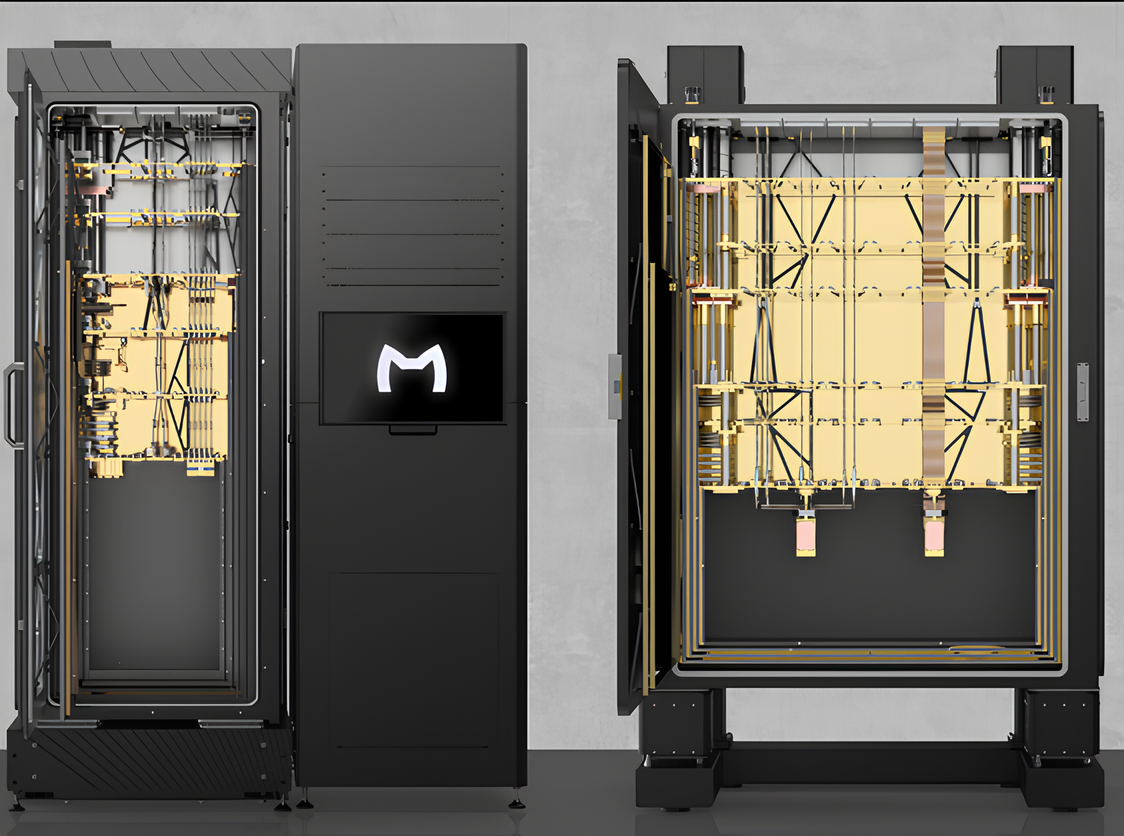
Guest Post by Jim McMahonSuperconducting qubits, which are used in quantum computers, are extremely sensitive to external influence. They need to be cooled to milli-Kelvin temperatures to maintain their quantum state and prevent decoherence, which is the loss of quantum information. Dilution refrigerators are the most widely used technology for achieving these ultra-low temperatures. They are essential for quantum computing because they cool superconducting qubits to near absolute zero (0 Kelvin or -273.15°C). Dilution refrigerators achieve such low temperatures by using a mixture of helium-3 and helium-4, which undergoes phase separation at very low temperatures, thereby absorbing heat and effectively cooling the system to the desired temperature.By providing a stable, low-temperature environment, dilution refrigerators allow quantum computers to perform complex calculations without being disrupted by thermal noise. Dilution refrigerators, while providing the necessary cooling, can introduce vibrations due to their internal components like pulse tubes, compressors, and pumps. Vibrations can also be introduced by external environmental sources from building HVAC systems, elevators, doors opening and closing, footfall near the equipment, and outside traffic and construction.These vibrations can interfere with the delicate quantum states of qubits, leading to errors and reduced computational accuracy. A vibration decoupling system for stability is, therefore, a critical requirement for dilution refrigerators to realize successful development and deployment of quantum computers. Various methods are used with dilution refrigerators to decouple vibrations. These include: Of particular concern to quantum researchers is low-frequency vibration near the pulse tube excitation frequency. The vibration isolation solutions listed here do not adequately cancel out frequencies down to 0.5 Hz vertically and horizontally. Vibration decoupling to this level would be considered an optimum performance objective for quantum computing within dilution refrigeration.Only one vibration isolation platform is capable of providing vibration decoupling to 0.5 Hz, that is Negative-Stiffness vibration isolation.Introduced in the mid-1990s by Minus K Technology, Negative-Stiffness vibration isolation has been widely accepted for vibration-critical applications, largely because of its ability to effectively isolate lower frequencies, both vertically and horizontally. The company’s isolators are used by more than 300 universities and government laboratories in 53 countries.Negative-Stiffness isolators are unique in that they operate purely in a passive mechanical mode. They do not require electricity or compressed air. There are no motors, pumps or chambers, and no maintenance because there is nothing to wear out. “Vertical-motion isolation is provided by a stiff spring that supports a weight load, combined with a Negative-Stiffness mechanism,” said Erik Runge, Vice President of Engineering at Minus K. “The net vertical stiffness is made very low without affecting the static load-supporting capability of the spring. Beam-columns connected in series with the vertical-motion isolator provide horizontal-motion isolation. A beam-column behaves as a spring combined with a negative-stiffness mechanism. The result is a compact passive isolator capable of very low vertical and horizontal natural frequencies and high internal structural frequencies.” Negative-Stiffness isolators achieve a high level of isolation in multiple directions, with the flexibility of custom-tailoring resonant frequencies to 0.5 Hz vertically and horizontally (with some versions at 1.5 Hz horizontally)*. When adjusted to 0.5 Hz, the isolators achieve approximately 93 percent isolation efficiency at 2 Hz, 99 percent at 5 Hz, and 99.7 percent at 10 Hz. (*Note that for an isolation system with a 0.5 Hz natural frequency, isolation begins at 0.7 Hz and improves with increase in the vibration frequency. The natural frequency is more commonly used to describe the system performance.)An early adopter of Negative-Stiffness platforms for vibration decoupling on dilution refrigerators used for quantum computing is Maybell Quantum Industries (Maybell).Maybell is a Denver-based quantum infrastructure company which has established itself as a global leader in quantum infrastructure performance and innovation. The company’s dilution refrigeration cryogenic platforms deliver premier reliability and usability for researchers and entrepreneurs.“Vibration on modern dilution refrigerators is mostly driven by two different sources,” said Kyle Thompson PhD, Founder and CTO with Maybell. “One of them is external low Hz vibrations. The other is the pulse tube refrigerator which pre-cools the cryostat. High pressure helium flows through the pulse tube at about one Hz (150 psi) creates low Hz vibrations. Both have the potential to be very detrimental to the qubits.”“It was critical for us to find vibration isolation that could decouple at these low frequencies from environmental and pulse tube noise,” added Thompson. “In particular, we were concerned about vibration transfer at frequencies close to one Hz.”“It was difficult to find vibration isolation that had a transfer function of one Hz,” continued Thompson. “The only one we found capable of isolating below one Hz was Negative-Stiffness vibration isolation developed by Minus K Technology. Their isolators have a 0.5 resonant frequency.”“Minus K’s Negative-Stiffness isolators can get a much lower transfer of energy at lower frequencies than we can get any other way,” explained Thompson. “That is why we are using them. We currently have Negative-Stiffness isolators integrated into our The Big Fridge model dilution refrigerator.”With a base temperature below 10 milli-Kelvin, capacity for more than 10,000 Flexline traces, and more than 130 L of sample volume, The Big Fridge provides the scale and performance needed for demanding quantum research.After decades of designing and working with dilution refrigerators, Maybell engineers understand how they fail. They engineered The Big Fridge to eliminate the biggest causes of downtime, maintenance, and failure.No Scroll Pumps: Maybell replaced maintenance-heavy, failure-prone circulation scroll pumps with micro roots blowers in The Big Fridge that provide decades of maintenance-free operation.Zero Acid-Flux Solder: The Big Fridge dilution unit components last longer by eliminating acid flux which causes corrosion, and solder which fails after extended cryogenic use.Minimal Rubber: Every inch of rubber in conventional dilution units is a guaranteed leak rate today and a potential failure point tomorrow. Maybell replaced the dozens of KF flanges used in alternative systems with welded joints and metal-to-metal flanges in The Big Fridge. (KF – Klein Flansch – flanges are used in vacuum applications in dilution refrigerators).Infinite Lifecycle Helium Traps: No more topping off LN2 again. Self-cleaning cycling helium traps keep The Big Fridge cold indefinitely.“On The Big Fridge we bolted the pulse tube to our chassis, then we floated the entire pulse tube and chassis on top of the Negative-Stiffness isolators,” said Thompson. “The Minus K isolators are what is separating our dilution refrigerator from internal and external vibrations and performing exceptionally well.”“Quantum computers right now are very much still in technical development,” added Thompson. “But the market is growing very fast and in five years it will be considerably bigger. Whether or not it will be at utility scale by then – performing commercial and industrial work that classical computers cannot – is yet to be seen.“Maybell’s industrial identity and engineering requirements are focused on designing systems for commercial and industrial applications,” explained Thompson. “We are closely looking at where quantum computing is going, and design our systems for that future, rather than a specific scientific application.Share this article:Keep track of everything going on in the Quantum Technology Market.In one place.
Tags
Source Information
Discussion
0 professional contributions
Sign in to join this professional discussion.
Be the first to add a constructive contribution.